What Is Sublimation Printing?
Sublimation printing is a technique in which special ink turns directly from a solid into a gas under heat and pressure, skipping the liquid phase entirely.
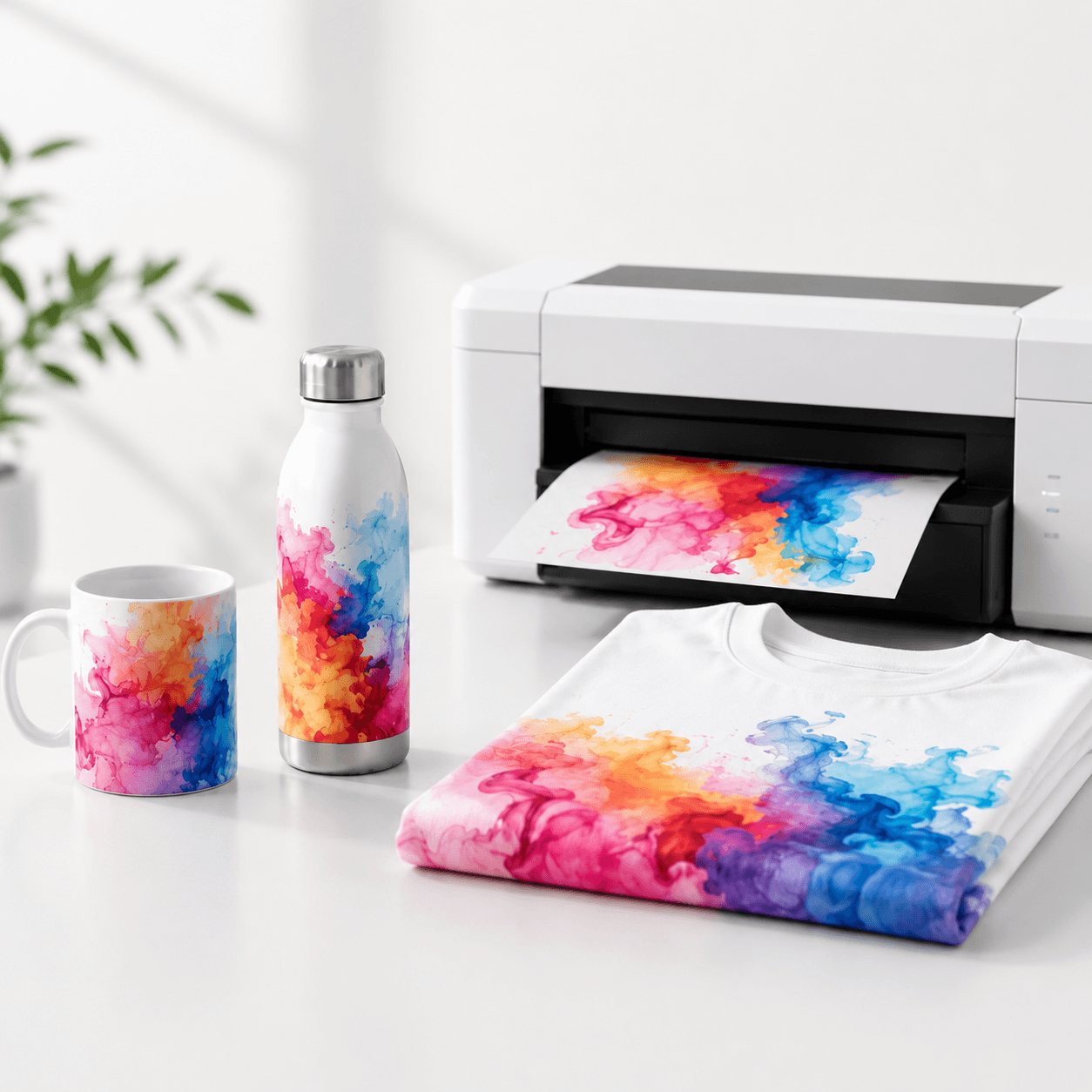
Sublimation printing is a technique in which special ink turns directly from a solid into a gas under heat and pressure, skipping the liquid phase entirely. The gas penetrates the material's fibers and bonds with them on a molecular level. The result is a print that doesn't sit on top of the surface but actually becomes part of it — it can't be felt by touch, and it won't crack or peel.
How the Process Works
The design is printed using a sublimation printer onto transfer paper, using CMYK inks.
The paper is placed on the material and both go into a heat press.
Under heat of around 190–200°C (375–390°F) and pressure, the ink turns into gas and penetrates the surface.
As the material cools, it hardens again and the print is sealed inside it.
What It Works On — and Why Not Cotton
Sublimation requires a material with polyester content (ideally 100% polyester) or a special coating that can accept the gaseous ink. That makes it well suited for:
T-shirts and sportswear made from polyester or polyester blends
Mugs, plates, and other items with a polymer coating
Puzzles, mouse pads, keychains
Flags, banners, and polyester textile signage
Phone cases and bags made from polyester fabric
Sublimation doesn't work on pure cotton. Cotton fibers lack the structure needed to "accept" the gaseous ink — it simply doesn't bond permanently with the fabric and washes out after the first wash. That's why 100% cotton t-shirts aren't suitable for this technique.
Advantages
Can't be felt by touch — the print is part of the fabric, not a layer on top of it
Doesn't crack or fade easily, holds up to many washes
Allows edge-to-edge (all-over) printing, including across seams
Excellent for detail and gradients, including photographs
Limitations
Only works well on light or white polyester surfaces — a dark background "eats" the colors, since there's no white underbase, unlike DTF
Not suitable for cotton or other natural fabrics
Requires enough polyester content (typically above 65%) for the color to appear saturated
Sublimation vs. DTF — At a Glance
Sublimation | DTF Printing | |
|---|---|---|
Material | Polyester / coated surfaces | Almost any fabric, incl. cotton |
Feel | Not felt, part of the fabric | Slightly felt, a layer on the fabric |
Dark fabrics | Doesn't work well | Works great (white underbase) |
Durability | Very high | High |
Typical use | Sportswear, mugs, promo items | T-shirts, hoodies, merch |
For more on the other technique, see our article ["What Is DTF Printing?"].